- County
- Peoria County
- Zip code
- 61602
- To downtown Peoria
- Along the river, south of downtown
- Typical home values
- Loft, condo & new-build projects
- School district
- Peoria Public Schools 150
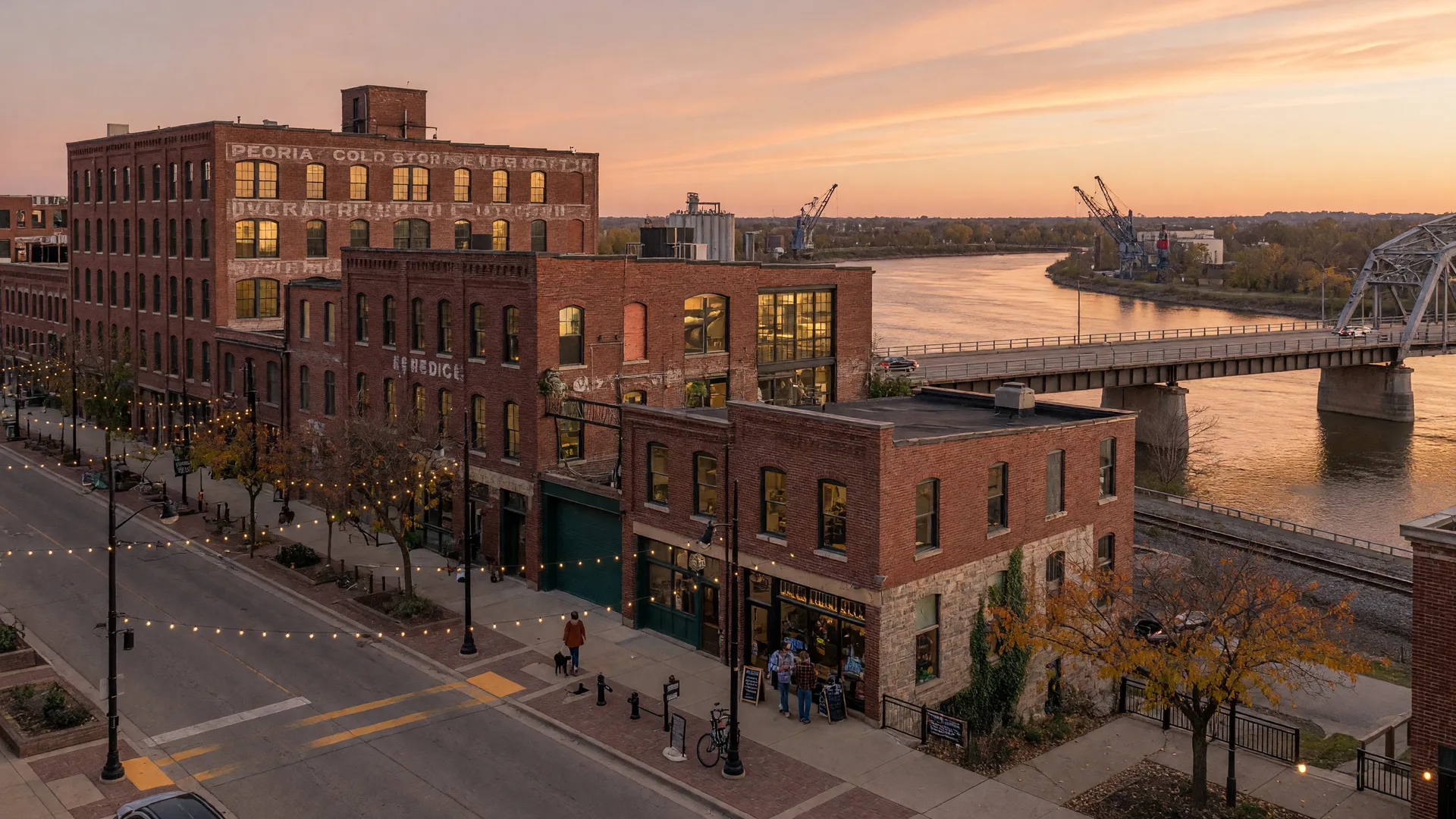
The Warehouse District is Peoria's riverside neighborhood of repurposed early twentieth century warehouses, wrapped around Dozer Park and home to some of the most active redevelopment in Central Illinois. It sits in a River Edge Redevelopment Zone, one of only five such designations in Illinois, and the city has been deliberately turning old industrial buildings into places people live, eat, and spend an afternoon.
The housing story here is not one price range yet, because the stock is changing fast: converted lofts, apartment projects sized in the hundreds of units, and a growing pipeline of residential projects approved or moving through city approvals. If you want the riverfront address with Downtown Peoria in walking distance, this is the neighborhood to watch.
What is the Warehouse District known for?
Baseball anchors the block. Dozer Park, home of the Peoria Chiefs, the St. Louis Cardinals' Class A affiliate, sits at the center of the district and gives the neighborhood its summer rhythm: ballgames, walk-up tickets, and the crowd spilling onto the riverfront after the last out. The ballpark got a visible refresh in 2026: at the Chiefs' home opener in April, the stadium unveiled a roughly $1 million field renovation that replaced the original 2002 infield with new sod and dirt and installed new outfield and warning track surfaces, joining the MLB-required expanded protective netting and the clubhouse upgrades completed over the past two seasons, a signal that the district's anchor keeps getting attention from the team and the league.
The food and drink scene leans into the buildings that built the neighborhood. BLACK BAND Distillery carries on Peoria's Whiskey City heritage with house-made bourbon, whiskey, gin, and vodka, and Thyme Kitchen + Craft Beer anchors a gastropub in the former Sealtest building. Analytical Brewing opened its taproom at 831 SW Adams Street, part of The Adams Street Center, on February 10, 2026, joining Warehouse on State, Glass Pour, Sugar Wood-Fired Bistro, and Wheel Art Pottery among the storefronts, along with the shops Discover Peoria highlights in its spend-a-day guide to the district, and Warehouse on State, the converted event center at 736 SW Washington Street, is the district's newest venue for weddings and gatherings. A Journal Star outlook counted more than a dozen restaurants, bars, and cafes expected to open in Peoria in 2026.
What is being built there right now?
The residential pipeline is moving, and the clearest current signal is The Clarke at 906. On September 22, 2026, the Peoria City Council unanimously approved an amendment to the mixed-use project at 906-910 SW Adams Street that grew the planned lofts from 8 units to 21 while keeping about 12,275 square feet of street-level retail, with planned amenities including a fitness center, sauna, patio space, and bike storage. The project, led by developer Bill Sullivan's WS Investments and estimated at roughly $5.5 million to $5.9 million, carries city TIF reimbursement support of up to about $1.1 million, and Assistant City Manager Kimberly Richardson told the Journal Star the added density boosts opportunities for surrounding commercial development. As reported in coverage of the project's June 2026 approval, the developer completed the property close in late September 2026, site plans moved through October, demolition is scheduled for late December 2026, and units could be available to lease by September 2028. As of this November 26, 2026 review, that published timeline still stands, the September 22 amendment remains the district's newest development decision on the books, and no construction start has been announced beyond the scheduled December demolition; the through-line is clear: developers are adding housing units, not cutting them.
Two more projects entered the fresh picture at this November 26, 2026 review. The Winkler Warehouses at 733 and 725 SW Washington Street, the former Roszell's Dairy buildings a half block from Dozer Park, are being redeveloped into 64 loft apartments plus three commercial units, one of the largest conversions in the district finally moving from paper to construction. And a separate plan by 801 Realty Partners targets about 78 rental units at 801 SW Washington Street, adding to the block across from the Oculus plans, per city council communications and local reporting; with the Oculus developer having finalized its purchases of 800 and 812 SW Washington, the 700 and 800 blocks of Washington now carry the district's densest concentration of residential projects in the pipeline.
The bigger projects keep the district's long game intact. The Oculus development at 800/801 SW Washington Street, a roughly $38 million plan to convert the two largest vacant warehouses into about 176 residential units plus commercial space, has been moving through city agreements since 2023, with roughly 300 parking spaces planned behind the 800 to 1000 block, a parking structure proposed at 905/907 SW Washington, and a property-tax rebate schedule that starts at 100% for 2027 through 2029 and steps down through 2043. The developer has finalized purchases of both buildings on the block, and Black Bear Capital Partners has the financing in place: a deal report from TRADED, recorded in March 2026, shows roughly $41.5 million arranged for the industrial-to-multifamily conversion. That picture sharpened at this November 26, 2026 review: Bracket Partners, which lists the five-story 800 SW Washington building as a roughly $27 million historic rehab of about 90 market-rate units, expects completion in December 2026, the closest the district's biggest conversions have come to delivering keys, while the 801 building and the block's parking and rebate structure remain in development. The January 2026 outlook still listed 800 and 812 SW Washington among the area's major residential projects to watch, so treat the details building by building rather than assuming a single move-in date for the whole Oculus plan. The former International Harvester Building at 1301-1309 SW Washington Street carries a $14.1 million conversion plan for 25 residential units plus commercial space; the city approved an inducement resolution in August 2025, though the project was still working through a construction contract dispute as of the latest reporting. The Grawey Building (Adams Street Center) at 809-833 SW Adams Street, Baldovin Development's roughly $9.8 million conversion of 16 apartments plus commercial space, cut its ribbon in November 2025 and is now open with apartments, restaurants, and shops. The district still waits on a full-service grocery anchor, and any plan for one remains speculative until an operator is announced. On the commercial side, the street-level storefront at 800 SW Adams Street, Suite 106, most recently home to the Pop-Up Chicken Shop, closed in early September 2026 and its roughly 5,525-square-foot space went up for lease in October, per an October 10, 2026 report, a reminder that storefront turnover is as much a part of the district's story as its new construction.
This past summer brought a visible touch too: in July 2026, new string lights went up through the district under a public-private partnership, the kind of streetscape change that makes the evening walk from the ballpark to the distilleries feel like a real neighborhood. The streetscape work is not finished either: a November 4, 2026 report from WMBD/Central Illinois Proud credited the district's rapid growth to infrastructure changes converting one-way streets to two-way, building renovations, and new restaurants, with Downtown Development Corporation CEO Chris Waible and local shopkeepers telling the same story of new storefronts and heavier foot traffic as the block evolves around Dozer Park.
Palate Tasting Room at 820 SW Adams Street, an education-focused beer, wine, and spirits tasting room, moved through city site approval and was slated to open in 2026, joining Analytical Brewing and the rest of the growing Adams Street Center lineup. November 2026 local coverage of the district highlighted how far the block has come: shopkeepers including The Modern Gentleman, which marked its two-year anniversary on November 2, 2026, credited Baldovin Construction's work for drawing them to the area, and Downtown Development Corporation CEO Chris Waible has called the district's growth rapid. Storefront turnover is still part of the story, as it is in any redeveloping district, but the direction of travel is unmistakable: new residential units on paper are turning into occupied storefronts and apartments on the street.
Underneath all of it sits a larger district vision. A master plan put forward for the area targets five mixed-use buildings with more than 500 residential units and roughly 700 parking spaces, and the residential stock already open or underway includes CHIC Apartments at 1029 SW Adams, the district's first ground-up new-construction apartment community, a five-story, 76-unit building with one- and two-bedroom floor plans, retail at street level, covered parking, and a package mail room, now leasing with published listings running roughly $1,695 to $2,150 a month, alongside the separate Chic Flats restoration of the former Chic Manufacturing Building at 1001 SW Adams into 22 condominiums. The district's gateway rental building, Adams & Oak at 810 SW Adams, has held roughly 90 apartments at the district's south end since 2024. The practical read for a buyer or investor is the same today as it has been all year: the district's housing is a project-by-project story, so the current listings, the specific building's timeline, and the monthly costs in that building matter more than any ZIP-level headline.
What kind of homes sell in the Warehouse District?
Today the housing is mostly conversions and new construction: lofts and apartments in former warehouse buildings, rental projects sized in the hundreds of units, and a handful of newer condominium properties on the edges of the district. Because so much of the stock is renovation or new build, prices are set project by project rather than by a single neighborhood median.
That is exactly why the useful number for buyers is not a headline: it is current listings and recent closings in the specific building you are considering. The freshest ZIP-level reads put 61602 in a tight, condo-driven range: Zillow's typical home value for the ZIP sits near $151,093 on its August 31, 2026 update, Redfin's ZIP-level median sale price is near $175,000 with a sale-to-list ratio near 95.3%, and its median listing price is near $181,000 across roughly 21 condo listings, with about 17 to 21 active listings in the ZIP at any one time. Recent 61602 sales tell the story in miniature: a two-bedroom, two-bath condo at 125 SW Jefferson closed at $110,000 in June 2026, and units at 123 SW Jefferson closed at $80,000 and $75,000 in November 2025. Active listings across the district still range widely building to building: units at 736 W Washington have listed from roughly $81,600 to about $408,000 depending on unit and finishes, new-construction CHIC condos at 1001 SW Adams have asked roughly $170,000 to $360,000, and a two-unit listing at 125 SW Jefferson has carried a $395,000 price tag. On the rental side, the district's loft and new-build product commands a clear premium over the city norm, with published listings running roughly $1,125 to $1,600 at Winkler Place, about $1,400 to $1,750 at The Lofts at Waterfront Place, and roughly $1,695 to $2,150 at the new CHIC Apartments, against a citywide average rent near $970 a month, one reason investors keep watching the district. A fresh September 2026 read of the district's rental board strengthens that story: about 61 Warehouse District apartments listed for rent at roughly $795 to $2,500 a month, with studios running about $795 to $1,600, and current examples including a two-bedroom at 812 SW Washington around $1,275, a studio at 733 SW Washington near $1,095, and a one-bedroom at 725 SW Washington near $1,195, per ApartmentHomeLiving and Rent.com listings, showing the rental premium holding into the fourth quarter. A fresh November 17, 2026 read from ApartmentHomeLiving put about 45 Warehouse District rentals on the market at roughly $795 to $2,750 a month, averaging about $1,779, the clearest current picture of the district's premium price point. The freshest market-level reads at this November 26, 2026 review point the same way: Realtor.com's district market page showed 8 homes for sale in the Warehouse District, down 44% from a year ago, and 4 rentals, roughly double the year-ago count, while new-construction listings at 1001 SW Adams have run from about $180,000 for a one-bedroom to about $369,000 for a two-bedroom, and an estimate from Nestimate put the ZIP's typical home value near $121,700 on its September 2026 index, down from a year earlier on its methodology, a swing that says more about the condo-heavy, low-volume sales mix than about any single trajectory. A fresh November 24, 2026 read of the district's market points the same direction: a REAIGENT7/Zillow-derived profile put the ZIP's typical home value near $121,653, down about 15.7% from a year ago on its methodology, with a median sale price near $169,850 after a median 33 days on market and a typical rent near $1,673 a month, the same honest caveat applying: 61602 is condo-heavy, low in sales volume, and one building can move a ZIP average more than any neighborhood trend. Estimated one-bedroom rents in the downtown and Warehouse District area run near $1,100 a month, about 46% above Peoria's citywide average, consistent with the district's standing as the region's premium riverfront address. One honest caveat: 61602 turns over roughly 40 sales in a trailing 12 months, so volume is thin and a single building can skew a ZIP average, which is why the practical questions are about the building itself: when a new project delivers, what the monthly assessment includes, and how the block is changing street by street. I am happy to walk through which projects are real and what the current comps say in the building you are watching. One broader ZIP-level read from RealtyTrac puts the median home value for ZIP 61602 near $208,000, about $243 per square foot, well above Peoria ZIPs like 61604 near $118,807, though district-level figures are thin and best treated as indicative rather than definitive.
Things to do in the Warehouse District
The river is the backyard. The Illinois River waterfront and the walkable riverfront corridor connect the district to Downtown Peoria's restaurants and the Peoria Riverfront Museum, and Dozer Park keeps the calendar full through baseball season.
Discover Peoria's own guide to the district sums it up simply: the neighborhood is best enjoyed on foot, from coffee and shops in the morning to a ballgame and the distilleries in the evening. In October the district hosted its own block party, BLOCKTOBERFEST, hosted by Baldovin Development Group on Adams Street by Dozer Park on October 24 with live music, food, and local vendor booths among the converted brick storefronts, now wrapped for the season. This October also brought new public art: a mural titled "Celebrate Generations, Peoria!," unveiled October 21, 2026 as an age-friendly Peoria project honoring older adults and intergenerational connection across the district. As the calendar turns, the district hosts the downtown holiday kickoff: Yule Like Peoria, confirmed for Friday, November 27, 2026, the day after Thanksgiving, right after the Santa Claus Parade rolls through downtown: a tree lighting at Kelleher's Irish Pub, refreshments, crafts, and Santa among the converted brick storefronts, historically running 3 to 6 PM. It is the rare part of Peoria where the nightlife, the redevelopment, and the housing are all happening on the same few blocks.
Is the Warehouse District a good investment?
The honest answer is that the district's bet is long term, and it is a local redevelopment story: hundreds of residential units moving through city approval, developers adding units this year, a gateway apartment building already leasing since 2024, and a streetscape built around Dozer Park and the river. Values across riverfront neighborhoods historically follow completed projects like these. What matters is that you buy with current numbers in a specific building, not on the neighborhood headline. A fresh development signal for investors arrived this week: nine census tracts across Greater Peoria were designated new federal Opportunity Zones, effective January 1, 2027, including parts of downtown, the Warehouse District, and the riverfront, a move economic development leaders say could draw private investment to the area, as reported by 25 News Now on November 11, 2026.
I track the Warehouse District's projects, closings, and listing activity as part of my monthly Peoria County updates. If you are weighing a loft, a new apartment, or a commercial storefront here, reach out and we will talk through the current numbers with no pressure.
Your Move Matters
Why work with a local agent in Warehouse District?
A guide can tell you about a town, but the number that matters for your move comes from current listings and closed sales. That is exactly what I bring to every conversation: real comps, honest comparisons, and no pressure.
I am Teri Shepherd, a Broker Associate with Keller Williams Premier Realty, licensed in Illinois (475.135244) and serving Peoria and Central Illinois for more than 10 years. Call or text me at 309-361-4592, or send a note through the contact page, and we will figure out which community fits your list.
Answer-first FAQ
Quick answers about living in Warehouse District.
The facts that come up in almost every conversation about Warehouse District, answered straight from current local data. From prices and commute times to the schools that serve the area, here is the short version before we talk.
What does housing cost in the Warehouse District in 2026?
There is no single neighborhood median yet, because the stock is mostly conversions and new construction: Zillow's typical home value for 61602 sits near $151,093 on its August 31, 2026 update; Redfin's ZIP-level median sale price is near $175,000 with a median listing price near $181,000 across roughly 21 condo listings and a sale-to-list ratio near 95.3%; recent sales have closed from about $80,000 to $110,000 in the Jefferson Street buildings; active district listings have run roughly $81,600 up to $408,000 depending on the building, from redevelopment shells to finished lofts like a two-bedroom unit at 736 W Washington asking near $408,000, with new-construction listings at 1001 SW Adams running about $180,000 to $369,000; a November 2026 read from Realtor.com showed 8 homes for sale in the district, down 44% from a year ago, and 4 rentals, about double the year-ago count, with an estimate from Nestimate putting the ZIP's typical home value near $121,700 on its September 2026 index; and on the rental side the new CHIC Apartments at 1029 SW Adams list roughly $1,695 to $2,150 a month against a citywide average rent near $970, with estimated one-bedroom rents in the downtown and district area near $1,100 a month, about 46% above the city average.
How far is the Warehouse District from downtown Peoria?
It is in the city already. The district sits along the river south of downtown, and the walkable riverfront corridor connects it to Downtown Peoria's restaurants and the Peoria Riverfront Museum, with Dozer Park as its center. Commutes to downtown employers, the hospitals, and the riverfront are a walk or a very short drive.
What school district serves the Warehouse District?
Peoria Public Schools District 150, the same city system that serves the rest of Peoria, with roughly 30 schools for about 13,000 students, plus charter and private options and the district's specialized and magnet programs. Because the city covers a lot of ground, I confirm the exact school assignment for any specific address.
Peoria Public Schools 150What is being built in the Warehouse District right now?
The clearest current signal is The Clarke at 906, where the Peoria City Council approved an amendment in September 2026 that grew the planned lofts from 8 units to 21 while keeping roughly 12,000-plus square feet of street-level retail, with demolition scheduled for late December 2026 and units potentially leasing by September 2028. The Winkler Warehouses at 733 and 725 SW Washington Street, the former Roszell's Dairy buildings a half block from Dozer Park, are being redeveloped into 64 loft apartments plus three commercial units, and a separate plan by 801 Realty Partners targets about 78 rental units at 801 SW Washington Street, joining the Oculus at 800/801 SW Washington Street, a roughly $38 million plan for about 176 residential units plus commercial space. The Grawey Building, or Adams Street Center, at 809-833 SW Adams Street cut its ribbon in November 2025 with 16 apartments plus commercial space, while Palate Tasting Room at 820 SW Adams Street, an education-focused beer, wine, and spirits tasting room, moved through city site approval in 2026, and November 2026 local coverage highlighted shopkeepers including The Modern Gentleman as the district's growth continues, and a district master plan targets five mixed-use buildings with more than 500 residential units and roughly 700 parking spaces, with CHIC Apartments at 1029 SW Adams already standing as the district's first ground-up new-construction apartment community, leasing 76 one- and two-bedroom units at roughly $1,695 to $2,150 a month, and Adams & Oak at 810 SW Adams operating as the gateway rental building since 2024.
Is the Warehouse District a good investment?
The district's bet is long term: hundreds of residential units moving through city approval, developers adding units this year, and a streetscape built around Dozer Park and the river. Values across riverfront neighborhoods historically follow completed projects like these, so the useful number is current listings and recent closings in the specific building you are considering, not the neighborhood headline. A new federal Opportunity Zone designation for parts of the district, effective January 1, 2027, is the latest development signal drawing investor attention.
Your Move Matters
The first conversation is where the clarity starts.
Whether you are buying a first home, selling a family property you have owned for years, or weighing an investment, we can start with a simple conversation about your goals, your timeline, and your numbers. No pressure, no obligation, just a plan you understand.