
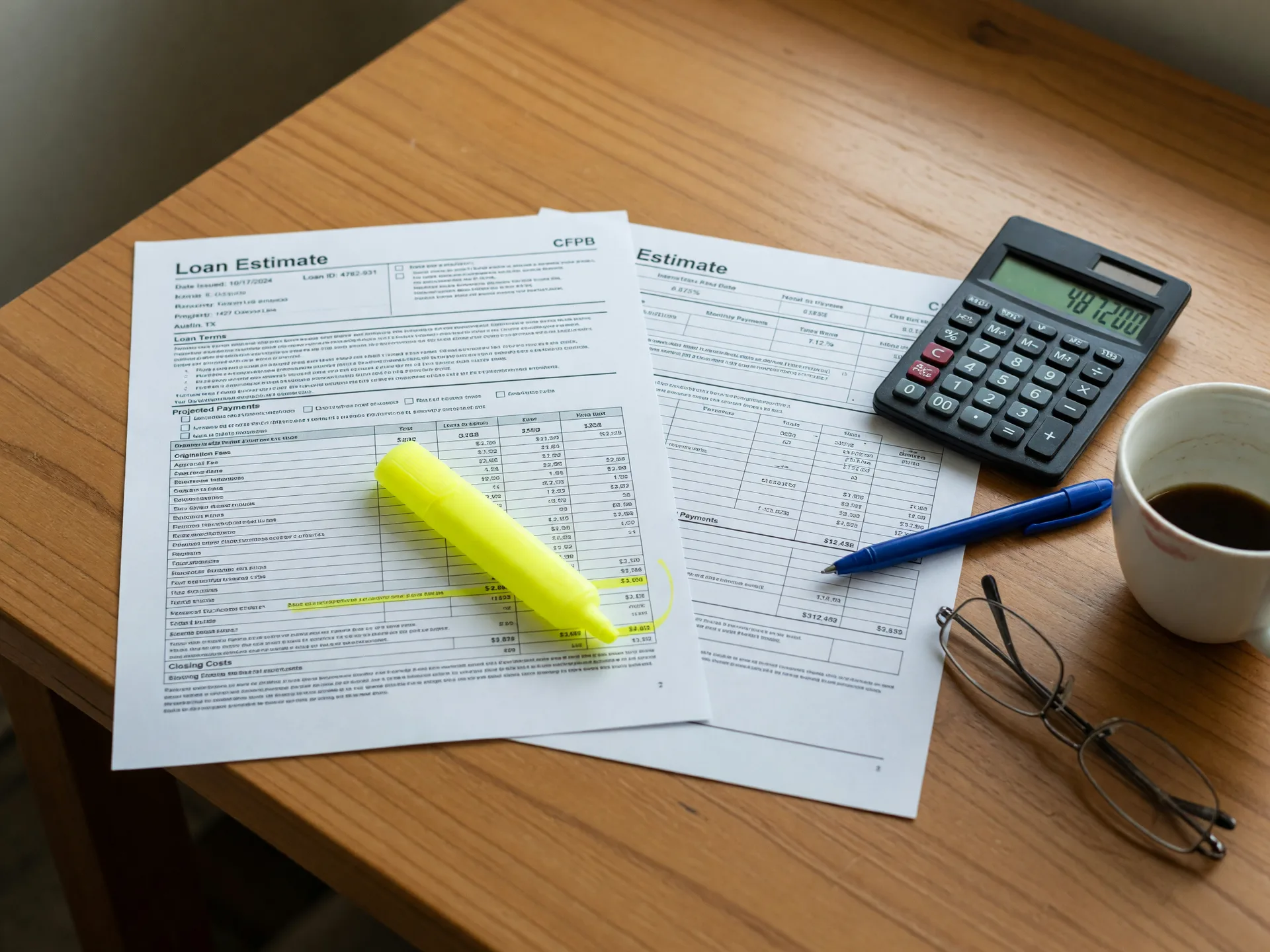
When two lenders quote the same interest rate, it is tempting to call it a tie and move on. It is not. The Loan Estimate, the same three-page form every lender is required to give you, is where the real comparison happens: interest rate versus APR, origination and underwriting fees, discount points, lender credits, and the full closing costs and cash to close. This article walks you through laying two Loan Estimates side by side, with a worked example at Peoria's current numbers. The whole point is simple. The lowest rate is not always the cheapest loan.
Reviewed October 19, 2026, with current Peoria numbers: the average 30-year fixed mortgage held at 7.40% in Freddie Mac's survey released October 15, 2026, and Peoria County's September 2026 median sale price was $175,000, down 1.4% from a year ago, per the RMLS Alliance Local Market Update. The worked examples below use a $140,000 loan, which is 20% down on a $175,000 home, rounded for illustration.
Start with the same loan, or the comparison means nothing
Before any number matters, the loans have to be the same shape: same loan amount, same program, same property, same down payment, same credit profile. Comparing a 30-year fixed quote against a 15-year quote, or comparing loans of different amounts, is not a comparison, it is a distraction. Ask every lender for a Loan Estimate on the exact same terms, and ask for them close together, because rates can move between quotes. Then lay the three-page Loan Estimates side by side and work the checklist top to bottom. You are entitled to a Loan Estimate within three business days of applying, and it costs you nothing to get several.
Interest rate versus APR
The interest rate on page one builds your monthly principal and interest payment, so it matters, but it is only half the story. The APR, the number printed next to the rate, blends the rate with certain loan costs and expresses the whole deal as one annual percentage, so it is the best first screen. Two lenders quoting 7.40% can show two different APRs, one higher because it carries points or heavier fees. A lower APR at the same rate usually means lower upfront cost; a lower rate with a higher APR usually means the fees are being paid somewhere. The catch is that APR assumes you hold the loan the full 30 years, so treat it as a first screen, never the final word, if you expect to move or refinance within a handful of years.
Origination and underwriting fees, the whole of Section A
Page two, Section A, is where the lender's own charges live: origination, underwriting, processing, and application fees, plus any discount points. This is the section that varies most from lender to lender and the one most buyers skip, because the names are bland labels for real money. The same rate can carry an origination fee of $1,250 at one lender and $2,950 at another, with underwriting layered on top. Add up the whole of Section A before comparing anything else, because it is the most controllable part of the comparison and it lands dollar for dollar in your cash to close. A lender who advertises no origination fee can still be charging $1,200 in processing and underwriting, so ask for the total of Section A and what exactly is inside it.
Discount points
A discount point is 1% of the loan amount, paid at closing to buy the rate down. On a $140,000 loan, one point is $1,400, and it typically buys the rate down about a quarter of a point, saving maybe $25 a month on the payment. The number to ask for is the break-even: if the point costs $1,400 and saves $25 a month, the break-even is near five years, meaning you come out ahead only if you still own the house long enough for the savings to catch the cost. Points are not bad, they are a prepayment, and they belong in the comparison only inside your time horizon. Every point you buy raises your cash to close today, which is exactly why the lowest monthly payment and the lowest cash to close are often different loans.
Lender credits
A lender credit is the inverse of a point: the lender charges you a higher rate in exchange for a credit toward your closing costs, reducing your cash to close. On the same $140,000 loan, a $1,000 lender credit is a real $1,000 off your bill at closing, showing up as a negative number in Section J, and it is worth roughly a quarter point of rate. That structure makes sense when cash is short and the plan is to move or refinance within a few years, because the higher rate never gets a chance to outrun the credit. Always ask what a credit costs in rate, exactly the way you ask what a point saves in rate, and then watch both numbers flow into cash to close.
The full closing costs and cash to close
Cash to close, the last line on page one, is the honest price tag of the loan: your down payment, plus closing costs and prepaids, minus earnest money and any lender credits. Sections B through J carry the rest of the closing bill, title insurance, settlement fees, the appraisal, recording, and the prepaid taxes, interest, and escrow. Illinois closing costs commonly run 2% to 5% of the purchase price on top of the down payment, and the loan-related slice can still vary by hundreds of dollars between lenders quoting identical rates. The title work belongs in the comparison too: even though the lender does not keep that money, lenders pair with different title companies, and the difference lands on your bill at closing. On a $175,000 home, a couple of tenths of a percent in title and settlement fees is a few hundred dollars, real money that belongs in the cash to close comparison.
Think of it as two questions in one: what does this loan cost me every month, and what does this loan cost me at the table? Cash to close answers the second one, the monthly payment answers the first, and the five-year cost on page three tries to answer both at once.
Worked example part one: same rate, very different cash to close
Say you are buying the median-priced home in Peoria County, $175,000, with 20% down, a $140,000 loan, quoted in a market where the average 30-year fixed sits at 7.40%. Lender A and Lender B both quote you 7.40%, no points. Lender A shows $1,250 in origination and underwriting; Lender B shows $2,950, plus a $750 processing fee and title work quoted about $400 higher. Identical rate, identical monthly payment, and Lender B still costs you roughly $2,850 more at closing, a cash to close about $2,850 higher on the same house. There is no math where B is the cheaper loan. This is exactly why the same rate can quietly be one of the most expensive loans on your table.
Worked example part two: the lowest rate versus the lowest cost
Then the second step: the lowest rate versus the lowest cost. Lender A offers 7.15% with one point, $1,400, and a $1,500 origination fee. Lender B offers 7.40% with a $750 fee and a $1,000 lender credit. Lender B costs about $3,000 less at closing, at roughly $25 more a month, a break-even near twelve years. If you plan to be in the house longer than that, Lender A wins over the life of the loan; if you expect to move or refinance in five to eight years, Lender B very likely costs you less in total. The cheapest loan is the one that costs you the least for the time you will actually hold it, which is why the answer genuinely depends on your plan.
Page three, the Comparisons box
Page three of the Loan Estimate carries a Comparisons box with the total interest paid over five years, the total of all payments over five years, and the APR. The five-year number is the closest thing to an apples-to-apples price tag, because it captures both the monthly cost and the upfront cost over a horizon most buyers actually live. One lender can structure the same rate with more upfront fees, and the five-year cost says so plainly. It is the single best shortcut for comparing two estimates that quote the same rate, and it is the check on the cash to close line: a loan with low cash to close can still be expensive over five years if the rate is high, and a loan with high cash to close can be the bargain if the rate is low enough.
The questions buyers are actually asking, answered with current numbers
Is the Peoria market slowing down? Yes in pace, no in price. Cumulative days on market stretched to 25 over the past year and September closings rose 6.7%, but the county median is $175,000, down 1.4%, and inventory sits at 1.5 months of supply. Slower does not mean cheaper, which makes the lender comparison matter more, not less, because financing terms are where the savings are found.
Do Peoria buyers have more negotiating power right now? More than last year, yes, especially on homes priced above their evidence. Seller-paid closing costs and rate buydowns show up in negotiation now, and a buydown is a lender credit in disguise, so the loan comparison is exactly what tells you what a buyer contribution is worth at your table. A seller credit of $5,000 toward closing costs changes your cash to close by $5,000, and it is worth more than a slightly lower rate on most loans.
Is renting still cheaper than buying? In Peoria, no, buying remains the cheaper monthly move, roughly $990 a month versus about $1,133 in rent on the Construction Coverage study reported by the Peoria Journal Star. The affordability gap comes right back to lender terms, so an extra $25 a month from one loan versus another is not noise, it is the whole difference some months.
Should Peoria buyers wait for mortgage rates to drop? Nobody can reliably predict rates, and the other side of the ledger is knowable: values held roughly flat year over year, and on a median-priced home a half-point drop is roughly offset by a $10,000 to $15,000 rise in price. What you can control today is the structure of your own loan, so shop it like a professional before you wonder about the market's timing, and if rates do fall later, you can refinance when the math supports it.
The short checklist before you pick
-
Get at least three Loan Estimates, and request them close together so rates do not move between quotes.
-
Compare the same loan amount, same program, same property, and same down payment, or the comparison is meaningless.
-
Circle cash to close on page one first, then add up Section A at every lender to see what is inside it.
-
Ask for the points and credits in dollars, and for the break-even on each, against the time you plan to hold the loan.
-
Read the five-year cost in the Comparisons box, and let it settle any tie between two loans with similar rates.
Let's put the numbers side by side
You do not have to become a loan expert to buy well in Peoria, and you should not have to. Every buyer I represent starts with a real buyer consultation, no exceptions, where we walk through your loan estimate, your payment, and your walk-away number together. I want you to understand exactly what you are comparing and I never want you to feel pressured into a decision. Call or text me at 309-361-4592, or send a note through the contact page, and we will put your lender options side by side before you choose. Getting the loan right is part of the move, and your move matters.
Sources: the Consumer Financial Protection Bureau's Loan Estimate form and disclosure guidance; Freddie Mac Primary Mortgage Market Survey of October 15, 2026 (average 30-year fixed 7.40%, unchanged from the week before); Peoria County Local Market Update, RMLS Alliance data, current as of October 5, 2026 (September median sale price $175,000, down 1.4%); and the Construction Coverage buying-versus-renting analysis as reported by the Peoria Journal Star. Worked examples are illustrative and rounded; your loan terms depend on your credit, your program, and your exact date of quote.
With gratitude,
Teri Shepherd · Broker Associate · REALTOR® · IL 475.135244 · Keller Williams Premier Realty, Peoria