
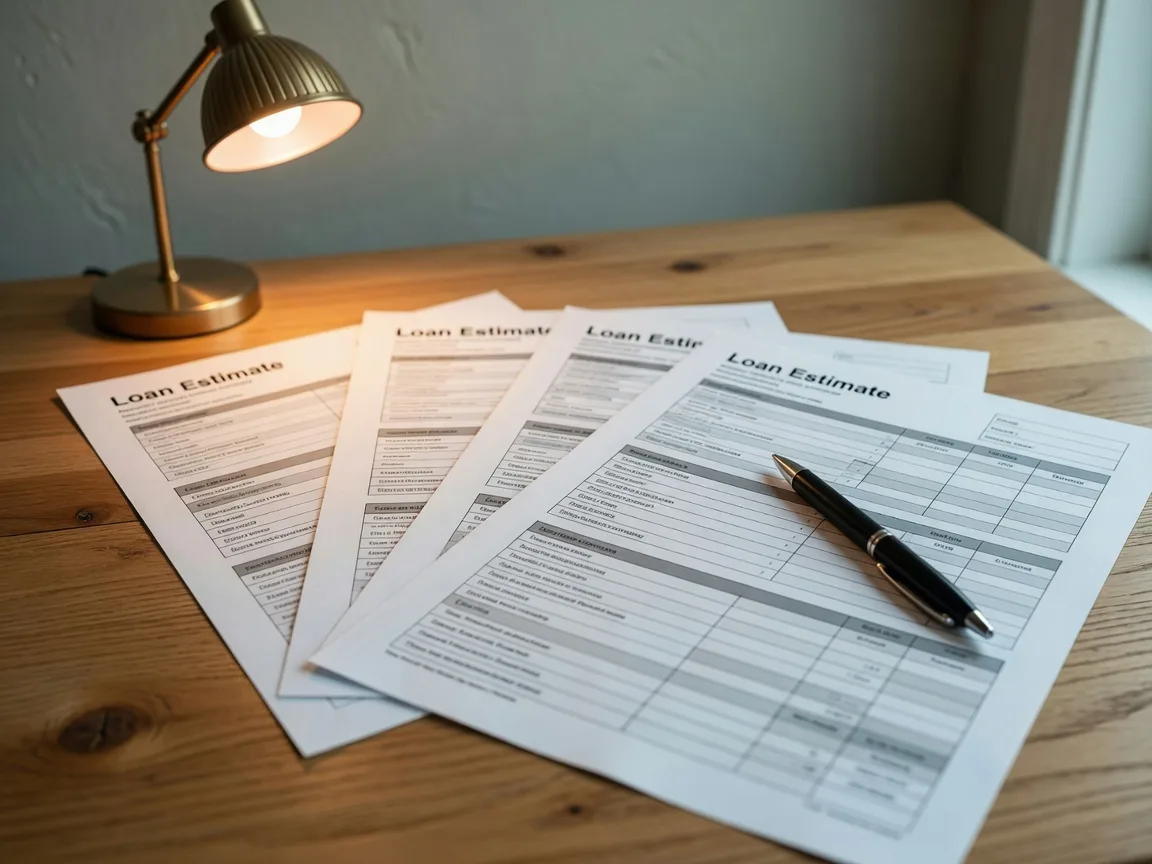
Every lender is required to give you the same three-page government form, the Loan Estimate, within three business days of taking your application. That sameness is your superpower: comparing lenders is not comparing sales pitches, it is reading the same lines across three or four documents and seeing where the numbers differ. With the average 30-year fixed rate at 7.28%, the difference between two lenders' costs can easily outweigh the difference between their rates, so the lowest rate is not always the cheapest loan. This guide walks the form page by page, line by line, so you can compare with confidence, no finance degree required.
A quick note before we start: get at least three Loan Estimates, on the same loan amount, same program, and same purchase price, and request them on the same day if you can, because rates move. Then set aside an afternoon and read them together. Your lender choice controls thousands of dollars of your life, so it is worth the attention.
Page one: the loan terms and the payment
The first page opens with the loan amount, the interest rate, the monthly principal and interest payment, and whether the rate can change after closing. That top block is where the headline numbers live, but it is only the beginning. Below it, the "Projected Payments" table shows your full payment with taxes and insurance, and the "Costs at Closing" box shows the estimated closing costs and the cash-to-close, the total you must bring to the table. Cash-to-close is one of the two most important numbers on the whole form, because it is the number you actually have to have in the bank.
Interest rate versus APR: the first screen
The interest rate is the price of the money, and the APR is the price of the whole deal spread out. The APR blends the rate with the loan's fees, including origination charges and discount points, into one annual percentage, which makes it the single best at-a-glance number for catching a lender whose low rate comes with high fees. If two lenders quote the same rate but different APRs, the higher APR is the more expensive loan.
Here is the catch that makes APR imperfect: it assumes you keep the loan for the full term. A buyer who pays points to buy down the rate looks worse on APR than on the monthly payment, even though the points can be the right move for a buyer who plans to stay. So read the APR first to screen lenders, then do the detailed comparison below before you decide. APR catches the fees; it does not tell you which structure fits your timeline.
Page two, Section A: origination and underwriting fees
Turn to page two and find Section A, "Origination Charges." Everything in that section is what the lender itself charges you: an origination fee, an underwriting fee, processing, and any discount points. These are the numbers to compare most carefully, because they vary enormously between lenders, from a few hundred dollars to several thousand, and they are the lender's cost of doing your loan plus its profit.
A common trick is to hide the true cost in this section. A lender who advertises "no origination fee" can still be charging $1,200 in processing and underwriting. The question is not what any single line is called, it is what the whole section adds up to. Add Section A across all three estimates and compare the totals before you look at anything else.
Discount points: paying a little now to pay less every month
A discount point is 1% of the loan amount paid at closing to lower your interest rate. On a $152,000 loan, one point is $1,520, and it typically buys the rate down by about a quarter of a percent. Points are not a scam and they are not a trap; they are a choice about how you pay for the loan. The question is whether you will stay in the home long enough for the lower monthly payment to repay what you paid upfront. That break-even point is usually around five years on a typical buydown, so a buyer who plans to stay a decade can benefit, and a buyer who may move in three years usually should not pay points.
Lender credits: the mirror image of points
A lender credit is the opposite of points: you accept a slightly higher interest rate, and the lender pays some of your closing costs in return. It lowers your cash-to-close today in exchange for a higher payment every month. Lender credits are how lenders advertise "no closing costs," and they are a legitimate tool, especially for a buyer who is short on cash but expects to refinance or move within a few years. Compare the credit against the higher payment it buys, and you will know whether it is a good trade for your situation.
The rest of page two: services, taxes, and prepaids
Sections B through J cover the other closing costs: title insurance, appraisal, settlement services, recording fees, and the prepaids like property taxes and homeowners insurance you fund at closing. Some of these vary by lender, and some are set by the state or the county, so do not panic when they differ. What matters is the total, and one honest shortcut: the same title company and the same insurance quote should appear across lenders, and if one lender's numbers look suspiciously low, ask whether they are estimates or locked quotes. In Illinois, closing costs commonly run 2% to 5% of the purchase price, so on a $175,000 home that is roughly $3,500 to $8,750, and it is part of the cash-to-close you need to plan for.
Cash-to-close: the number that matters most
Cash-to-close is the total you bring to the closing table: down payment plus closing costs, minus any lender credits and any earnest money you have already put down. It is on page one, and it is the number your bank account actually has to cover. Two lenders can quote the same rate and the same payment while one asks for $4,000 more at closing, so compare cash-to-close line by line, and ask the lender to explain every difference you do not understand. A lender who cannot explain their own numbers is telling you something.
Page three: the Comparisons box
Page three holds the underused truth-teller: the "Comparisons" box. It shows the total interest you will pay over the life of the loan, the percentage of the loan amount you will pay in interest, and, most usefully, the total you will have paid in principal, interest, and mortgage insurance after five years. That five-year number corrects for lenders who structure the same rate differently, and it is the closest thing the form has to an honest bottom line for the way most people actually live in a home. Compare the five-year cost across lenders and you will see the real winner more clearly than any single rate.
The worked example: why the lowest rate is not the cheapest loan
Here is the comparison in action. On a $152,000 mortgage, Lender One quotes 7.03% with one discount point and a $1,500 origination fee, roughly $3,000 in lender charges. Lender Two quotes 7.25% with no points, a $750 origination fee, and a $1,000 lender credit, roughly $3,000 less at closing. Lender One has the lower rate and the lower monthly payment, about $20 to $25 less per month. Lender Two has the higher rate but costs about $3,000 less to get into the loan. The break-even between them is near twelve years, so the buyer who plans to stay a decade or more may prefer Lender One, and the buyer who expects to move or refinance within five years is better off with Lender Two. Same loan, same house, two different right answers, and the "lowest rate" was the more expensive choice for one of them.
That is the whole point of this exercise: the cheapest loan is the one that costs you the least for the time you will actually hold it, and the Loan Estimate is the form that lets you see it. If you would like help reading your Loan Estimates, or a second set of eyes before you commit, call or text me at 309-361-4592, or send a note through the contact page. I will walk through the lines with you, no pressure, and you will know exactly what you are signing and why, because your move matters.
The short checklist before you pick
-
Get at least three Loan Estimates on the same loan amount, program, and price, requested close together.
-
Compare the APR first to screen lenders, then dig into the details.
-
Add up Section A across lenders: origination, underwriting, processing, and points.
-
Run the break-even math on any discount points or lender credits against your planned time in the home.
-
Compare the full cash-to-close, and ask the lender to explain every difference.
-
Check the five-year cost in the Comparisons box before you decide.
With gratitude,
Teri Shepherd · Broker Associate · REALTOR® · IL 475.135244 · Keller Williams Premier Realty, Peoria